Delphine Cross
The Wife He Threw Away: A Billionaire Secret Baby, Marriage-in-Crisis, Second-Chance Grovel RomanceDelphine Cross is the person who turns Ada Hart’s escape into a life that can endure. She enters Maison Cendre as a young woman looking for work, becomes Ada’s closest friend and business partner, and helps build a house whose independence rests on formulas, authorship, and the refusal to let another powerful name absorb what Ada created. Her importance is practical as well as emotional: Delphine sells what Ada makes, protects the secrets surrounding Theo Hart, and repeatedly gives Ada the material and moral security needed to refuse Sebastian Vale on her own terms.
Identity and Introduction
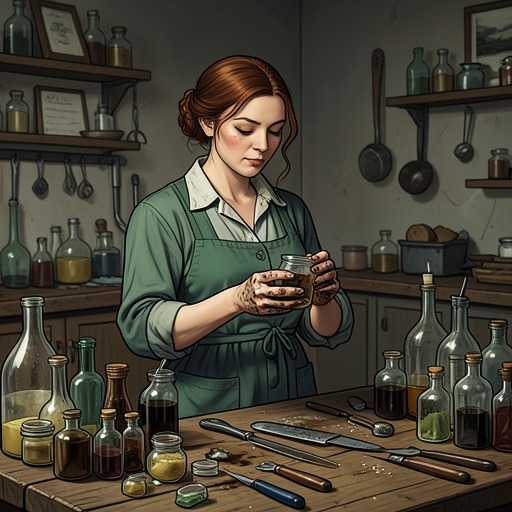
Delphine first appears during the winter after Ada reaches Paris, when she comes in from the rain asking for work. She is described as being all elbows and dark curls, with a mouth that cannot keep a straight face. She is hired to mind the counter, but quickly begins to mind Ada as well. She learns Ada’s orders before Ada gives them and never demands an explanation for the founder who sometimes weeps over perfume accords at midnight. By spring, Delphine has become the nearest thing to family that Ada is willing to accept. Ada has concealed her true name, yet Delphine loves her without requiring the confession first; after betrayal, that unforced loyalty is the kind of love Ada can trust.
Delphine is twenty-six when she helps Ada through childbirth. She is the daughter of a chemist, and her entrance into that crisis is immediate rather than ceremonial: summoned through the door at two in the morning, with wet hair, fierce dark eyes, and no coat, she sees Ada sweating through Estelle’s good linen and rolls up her sleeves. Estelle provides the older, immovable authority in the room, while Delphine supplies youth, certainty, and action. The scene establishes a pattern that governs their later partnership: Delphine does not merely sympathize with Ada’s danger; she steps into it and makes herself useful.
Building Maison Cendre
The founding of Maison Cendre depends on Delphine’s willingness to follow Ada before either of them possesses conventional security. Ada names the house Cendre, meaning ash, a choice Delphine initially considers madness because luxury fragrance is not normally named for the gray remains at the bottom of a grate. She accepts the name when Ada explains its philosophy: Cendre is not the fire but what the fire could not take, the substance left after sweetness, decorative surface, and self-deception have been burned away. Delphine therefore becomes one of the first people to understand that the house is not simply a commercial venture. It is Ada’s theory of survival made public.
Their division of labor is unusually clear. Delphine takes the outside world so Ada can take the bench. She handles buyers, profiles, and men who come looking for an opening in a house run by two women without a dynasty behind them, while Ada remains in the atelier with Estelle’s perfume organ and builds the compositions. The arrangement protects both the work and the worker: Ada’s attention is not consumed by negotiation, and Delphine’s commercial labor is not treated as secondary to the creative act. Maison Cendre grows quietly and evenly, like ash settling into everything.
The partnership is formalized in a compact promise made when Maison Cendre is still only one rented room, a pregnant woman with a grudge and a nose, and Delphine’s scrutiny of Ada’s books. Delphine tells Ada, “You make it, I’ll sell it, and we never let a man sign anything.” The rule preserves the distinction between making and marketing without allowing either sphere to be appropriated by male authority. It also anticipates Ada’s later insistence that her formulas and name must remain attached to her work in any relationship with Vale Group.
Delphine is not merely an executive counterpart. She is Ada’s second, her partner in the house, and the godmother who teaches Theo the word “crown.” She knows the full shape of what Ada walked out of, including the history Ada does not disclose to the wider world. That knowledge is not used as leverage. It becomes a protected common possession, allowing Ada to build a public identity as the founder of Maison Cendre without surrendering the private truth behind it.
Guardian of Secrets and Boundaries
Delphine’s loyalty becomes most concrete when Sebastian seeks access to Theo. She knows that the boy’s gray eyes resemble Sebastian’s when he concentrates on his lions, and she guards that knowledge like a second heart. When Ada agrees to a supervised meeting, she imposes conditions designed to keep the encounter within her control: it must take place in her atelier, on her ground, for twenty minutes, with the outcome determined by her. Theo must remain sealed upstairs in the apartment with Delphine, the door closed and no foot on the stairs until the last black car has left the street.
Delphine does not ask why these arrangements are necessary. Her silence is evidence of understanding, not indifference. She agrees to organize both the meeting and the boy, thereby converting friendship into active protection. During the supervised-visitation arrangement, Ada also forbids any mention of the past or of fatherhood, excludes press and security from the doorway, and makes the visit revocable at any moment. Delphine’s role is to make those boundaries real. She helps ensure that Sebastian’s wealth, family name, and institutional power cannot enter Maison Cendre simply because he has arrived at its door.
Her support is not blind obedience. When Ada hesitates over what to do about Sebastian, Delphine tells her that Ada has never once done the wrong thing to Sebastian Vale and suggests that perhaps it is time. The remark identifies a moral imbalance in Ada’s conduct: Ada has spent years protecting Sebastian from consequences even while protecting herself and Theo from him. Delphine’s intervention urges Ada to distinguish compassion from surrender and justice from the old reflex of accommodating the man who once controlled the terms of her life.
Business Authority and the Merger Conflict
Delphine remains present when Maison Cendre’s independence becomes a corporate question. Ada can contemplate business with Vale Group only in forms that preserve control over the house. The possible arrangement may involve distribution or a house account, but it cannot require Maison Cendre to disappear into the larger machine. When Ada later proposes a merger of equals, she demands that Maison Cendre’s formulas and name be placed permanently in the founding documents, protected from the quiet removal that a press release could accomplish. She also requires Chloe Beaumont’s name to be removed from the company’s materials, treating the restoration of authorship as the price of her silence and the foundation of any alliance.
Delphine’s significance in this negotiation lies in what the proposal protects. She helped create the house under a rule that no man would sign what Ada made, and the merger can succeed only if that rule is translated into institutional language. The arrangement is therefore not a surrender of the independent house Delphine built with Ada. It is an attempt to make Maison Cendre’s independence durable even while its business reaches the scale of Vale Group.
The contrast with Sebastian’s earlier world is sharp. Vale Group possesses an unmarked, thumbprint-secured Éternel laboratory on its twenty-second floor, a private kingdom Sebastian built for Ada during the first year of their marriage. Maison Cendre, by contrast, is not a gift from a husband inside a glittering machine. It is a structure Delphine helps Ada make from rented rooms, exposed accounts, long work, and a refusal to let credit be displaced. In that contrast, Delphine represents the difference between protection granted by power and protection created through partnership.
Friendship, Marriage, and the Old Enemy
Delphine’s bond with Ada reaches beyond the founding years. She holds Ada’s hair when pregnancy leaves her terrified, broken, and close to folding, and she holds Ada’s nerve when Ada needs someone else to sustain the decision she has already made. At Ada and Sebastian’s later wedding in the Grasse jasmine fields, Delphine serves as maid of honor. She stands in slate silk, already crying while pretending not to, among the people who actually built the life being celebrated. Estelle stands nearby with her cane planted in the ground she once walked as a girl, and Theo Hart carries the rings on a cushion he keeps forgetting is part of his duty.
The wedding also reveals that Delphine’s life contains an unresolved history of its own. After the reception, she takes a business call away from the lanterns, breaking her usual rule never to take calls after ten. Ada knows every register of her and recognizes that something in Delphine has gone quiet and wrong. The change matters precisely because Delphine is normally the reliable interpreter of crises; for once, she is the person whose crisis cannot be managed by her competence alone.
The threat is connected to the Cross family. When Delphine is confronted by a stranger who greets her as “Mrs. Cross,” she goes white. She later explains that there was a marriage and a debt, first his and then hers, until she ran before the situation could close over her head. Her language deliberately echoes Ada’s experience of flight, and Delphine recognizes the connection when she says that Ada of all people understands running. The revelation enlarges Delphine from guardian into a character with her own concealed escape and suggests that the old systems Ada resisted have not been confined to the Vale family.
Her response is not passive fear. Delphine tells the stranger’s intermediary that she does not care what he is offering and instructs the message to be delivered to Sabine: “if the Cross family wanted a war, they should have finished the first one.” The statement gives her private history a political edge. She is not simply being dragged back into an old debt; she is prepared to name the previous conflict and refuse the assumption that her silence can be purchased.
Narrative Role and Significance
Delphine functions as the human infrastructure of Ada’s second life. Estelle gives Ada craft, but Delphine gives that craft circulation, protection, and institutional form. She sees the founder, the mother, and the frightened woman together rather than reducing Ada to any one of them. Her partnership makes Maison Cendre’s authorship principle practical: Ada creates, Delphine sells, and neither allows a man’s name to occupy the place where a woman’s labor belongs.
She also provides the novel’s clearest alternative to the manipulative alliances surrounding Sebastian Vale. Chloe Beaumont offers Sebastian effortless affirmation while concealing a lie; the Vale family offers control disguised as protection; Delphine offers neither flattery nor possession. Her loyalty is demanding because it asks Ada to defend herself, her child, and her work rather than return to dependence. Through Delphine, friendship becomes a counter-family: a chosen structure in which secrets are guarded, labor is divided fairly, and authority is shared rather than inherited.
At the same time, Delphine is not an uncomplicated emblem of safety. Her own marriage, debt, flight, and the sudden appearance of a Cross-family enemy show that the person who protects others also carries an unfinished past. Her whiteness at the greeting of “Mrs. Cross” briefly reverses the usual arrangement between the two women. Ada, who has so often been the hidden and threatened one, must now witness Delphine’s concealment cracking open. That reversal gives Delphine independent narrative depth and prepares the story for a new conflict after Ada’s marriage has been rebuilt.
By the end of the available arc, Delphine remains beside Ada as friend, maid of honor, co-owner, and keeper of the family’s difficult truths. She is present at the wedding that publicly restores Ada and Sebastian, but her own interruption afterward prevents the celebration from becoming a final closure. Maison Cendre may have secured its name and partnership, yet Delphine’s warning about the Cross family establishes that survival is not the same as permanent safety. Her role is to make the new life possible—and to remind the story that every protected house has a door through which the past may still return.